



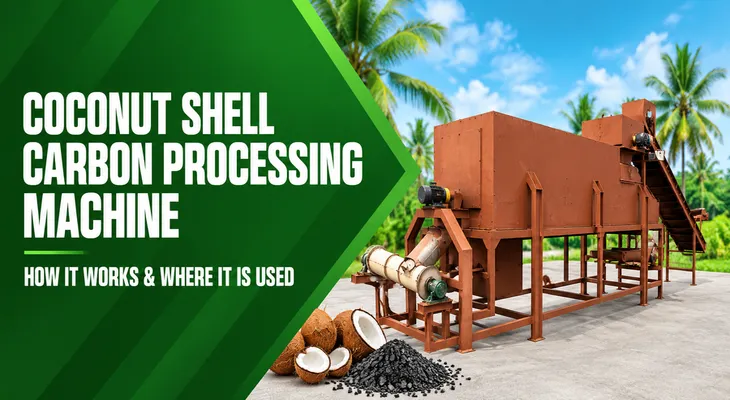
Coconut Shell Carbon Processing Machine: How It Works & Where It Is Used
Oct 26,2026
Coconut shells are primarily viewed as agricultural waste; however, they are recognized for their use in industry when converted correctly. They are rich in carbon and may be converted into various carbon-based products such as activated carbon, which has several applications ranging from purification of water and uses in industry to filtration of air and treatment of wastewater.
A coconut shell carbon processing machine transforms coconut shells into carbon-based materials. The process generally involves a number of preliminary activities such as coconut shell crushing, carbonization, activation, cooling, and grading, depending on the raw materials and the requirements of production.
Understanding about the way the machine works, as well as the information on the usage of finished products, can give businesses a possibility to take advantage of coconut waste collection for carbon production.
How Does a Coconut Shell Carbon Processing Machine Work?
The processing procedure depends on the type of product being produced. Nonetheless, it is common for the production line to include various key stages:
Raw Material Collection and Preparation
This involves the gathering of coconut shells from coconut processing units, copra producers, and other sources of agricultural products. The gathered shells are cleaned in order to remove any unwanted materials and prepare them for processing.
Depending on the type of machines used, the shells may have to be broken into smaller pieces so that they can move easily and be evenly processed. It is also necessary to monitor moisture levels, as high levels of moisture can negatively affect heating efficiency and carbonization processes.
Crushing and Size Reduction
When smaller feed material is needed in production processes, the coconut shells are sent to a machine or crusher known as a size-reduction machine for crushing. By crushing the coconut shell, a more uniform size can be obtained, which leads to easier handling of the material.
The required size is determined by carbonization equipment and properties of the final product. Not all the lines of production need the crushing stage. Some of the systems allow processing coconut shell larger pieces without a need for crushing.
Carbonization
During this process, the coconut shells are heated while being limited in oxygen supply for the temperature and time period required for carbonization. Through this process, the volatile substances are eliminated, and coconut shells are converted into charcoal.
The efficiency of the process in obtaining coconut shell charcoal is to some extent affected by temperature, heating time, moisture content of the input material, and the amount of oxygen supplied during the process.
The equipment used for carbonization is designed in such a way that it allows for maintaining the required parameters of the process. Moreover, this equipment helps to reduce the amount of smoke and burned gas emitted during the process of carbonization.
Usually, the product obtained at this stage is coconut shell charcoal, which can be used as an energy source or further processed for producing activated carbon.
Activation for Activated Carbon Production
If activated carbon is what is needed, then there must be another stage of activation. Carbonization alone is not enough to produce activated carbon.
In order to complete the activation process, the charcoal needs to undergo a special treatment that involves air and steam as well as chemical processes appropriate for the production method. This results in the formation of a porous structure and an increase in surface area.
The presence of pores in the activated carbon gives it the ability to absorb different contaminants from liquid and gas states. Special conditions during the process must be maintained to ensure the great performance of the adsorbent.
Cooling and Final Processing
Once carbonization or activation has occurred, it is essential to cool the substance appropriately to inhibit oxidation and limit fire hazards. The carbon produced can now be crushed, sieved, and categorized, depending on its use.
Different sizes of the end product, such as granular and powdered carbon, can also be produced. Prior to distribution, the product is subjected to an examination according to specific quality standards, which for activated carbon include ash content, moisture, strength, particle size, and adsorption capacity.
Where Is Coconut Shell Carbon Used?
- Water cleaning and wastewater treatment: Activated carbon removes various organic materials, chlorine, bad flavor, and smell from water, and diminishes some specific pollutants in the industrial wastewater sector.
- Air cleaning and gas treatment: Activated carbon adsorbs some hazardous gases and volatile organic compounds in air cleaning and ventilation systems.
- Food processing: Food-grade activated carbon can be used in the separation and cleaning processes in cases such as the treatment of cooking oil and sugar.
- Pharmaceutical and chemical production: It serves to remove undesired colors in pharmaceutical and chemical products.
- Gold extraction: The activated carbon of coconut shells is responsible for the extraction of gold from solutions in which it is involved.
- Fuels and heat production: The charcoal obtained from coconut shells can also serve as a solid fuel depending on its carbon content, moisture, ash content, and heat value.
In Summary
Creating carbon from coconut shells can be very helpful in creating a commercial product from the coconut fruit that has become useless. From the processing of the material to carbonization and activation, as well as final grading, one can achieve a result that meets the requirements and standards for the final product.
For businesses planning to enter this sector, definitely try Essar Engineers for quality coconut shell carbon processing machines that create practical opportunities to convert agricultural waste into valuable industrial resources.