



Benefits of Using Coco Peat Grow Bags in Modern Agriculture
Sep 28,2026
Modern agriculture is continuously evolving to meet the growing demand for food while using natural resources more efficiently. Among the many innovative growing solutions available today, coco peat grow bags have become increasingly popular among farmers, greenhouse growers, horticulturists, and home gardeners. Made from coconut husk fibre, coco peat is a sustainable growing medium that offers excellent moisture retention, aeration, and root support.
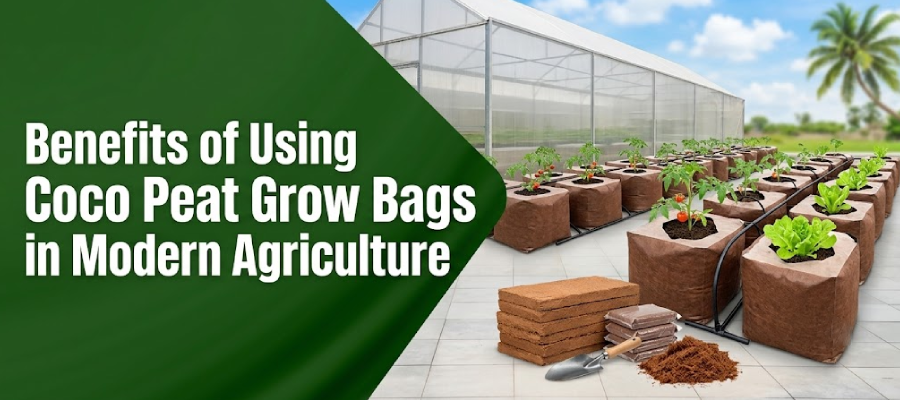
Coco peat grow bags provide a convenient and efficient alternative to traditional soil-based cultivation. They are particularly useful for greenhouse farming, hydroponic cultivation, nursery production, and commercial vegetable farming. Here are some of the major benefits of using coco peat grow bags in modern agriculture.
Excellent Water Retention
One of the most important advantages of coco peat is its ability to retain moisture. Coco peat can absorb and hold a significant amount of water while still allowing excess moisture to drain away.
This helps maintain a consistent moisture level around plant roots and reduces the frequency of irrigation. For commercial farmers, better water management can contribute to efficient irrigation practices and help reduce unnecessary water consumption.
Better Root Aeration
Healthy roots require both water and oxygen. If the growing medium becomes too compact, air circulation around the roots can be restricted, which may affect plant growth.
Coco peat has a naturally porous structure that allows air to circulate through the growing medium. This provides better oxygen availability to the root zone and supports healthy root development. Better aeration can be particularly beneficial for crops grown in controlled environments such as greenhouses and polyhouses.
Promotes Healthy Plant Growth
The physical properties of coco peat create a favourable environment for root development. Its lightweight and loose structure allows roots to spread easily through the growing medium.
When combined with appropriate fertilizers and nutrients, coco peat grow bags can provide a controlled growing environment for various crops. This makes them suitable for vegetables, fruits, flowers, herbs, and ornamental plants.
Sustainable and Eco-Friendly Growing Medium
Coco peat is produced from coconut husks, which are a natural by-product of the coconut industry. Using this material as a growing medium helps make productive use of agricultural waste.
Unlike many conventional growing materials, coco peat is biodegradable and renewable. Its use can support more sustainable agricultural practices while reducing dependence on traditional soil resources.
Lightweight and Easy to Handle
Coco peat grow bags are significantly easier to transport and handle compared with heavy soil- filled containers. Their lightweight nature makes them convenient for greenhouse farming, terrace gardening, nurseries, and vertical farming systems.
Farmers and growers can position or replace grow bags with less physical effort. Their compact design also makes them easier to store and transport before use.
Suitable for Controlled Environment Agriculture
Modern farming increasingly uses greenhouses, polyhouses, and other controlled growing environments to improve crop production. Coco peat grow bags are well suited for these systems because they provide a consistent and manageable root-zone environment.
Growers can control irrigation, nutrient application, temperature, and other growing conditions more effectively. This can help improve crop management and create more uniform growing conditions.
Reduces Dependence on Soil
Soil-based farming can face challenges such as poor soil structure, soil-borne diseases, salinity, and nutrient imbalance. Coco peat grow bags provide an alternative growing medium that allows growers to cultivate plants without relying entirely on natural soil.
This is especially useful in areas where agricultural soil quality is poor or where space is limited. Coco peat-based cultivation can also be integrated into urban farming and protected cultivation systems.
Helps Improve Water and Nutrient Management
Coco peat can retain moisture and nutrients around the root zone while allowing excess water to drain. This makes it easier for growers to manage irrigation and fertigation according to crop requirements.
When used with a properly designed irrigation system, coco peat grow bags can support precise delivery of water and nutrients. This approach can help reduce wastage and create a more controlled growing environment.
Versatile for Different Crops
Another major advantage of coco peat grow bags is their versatility. They can be used for a wide range of crops, including tomatoes, cucumbers, capsicum, strawberries, leafy vegetables, flowers, herbs, and nursery plants.
The size and composition of grow bags can also be selected according to the crop, growing system, and cultivation requirements.
Ideal for Modern and Urban Farming
As urban farming continues to grow, growers are looking for compact and efficient cultivation solutions. Coco peat grow bags are suitable for balconies, terraces, rooftops, greenhouses, nurseries, and commercial farms.
Their lightweight structure and efficient use of growing space make them a practical option for growers who want to cultivate plants in limited areas.
Conclusion
Coco peat grow bags offer several advantages for modern agriculture, including excellent moisture retention, improved root aeration, lightweight handling, sustainable resource utilization, and better control over irrigation and nutrient management. Their versatility makes them suitable for commercial farming, greenhouse cultivation, nurseries, hydroponic systems, and urban agriculture.
As agriculture moves toward more sustainable and resource-efficient cultivation methods, coco peat grow bags can play an important role in creating productive and manageable growing environments. Choosing high-quality coco peat grow bags and using them with appropriate irrigation, drainage, and nutrient management practices can help growers establish healthier and more efficient cultivation systems.